Stop Asking If Your Design Software Has AI. Ask This Instead
Who can deliver a compliant drainage design — and how fast?
August 2026
If you are a civil engineer evaluating design software right now, you are being sold the word AI from every direction. Autodesk says AI. The start-ups say AI. The word has been stretched so thin that it no longer tells you anything useful.
So in this article I want to give you something more useful than a word. I want to give you a scale.
Over my last few articles, I have written about Agentic Infrastructure Design — the discipline I call AID — from several angles: agent skills, dynamic memory, the three phases of AI in civil engineering. Each of those articles described a piece of the transition.
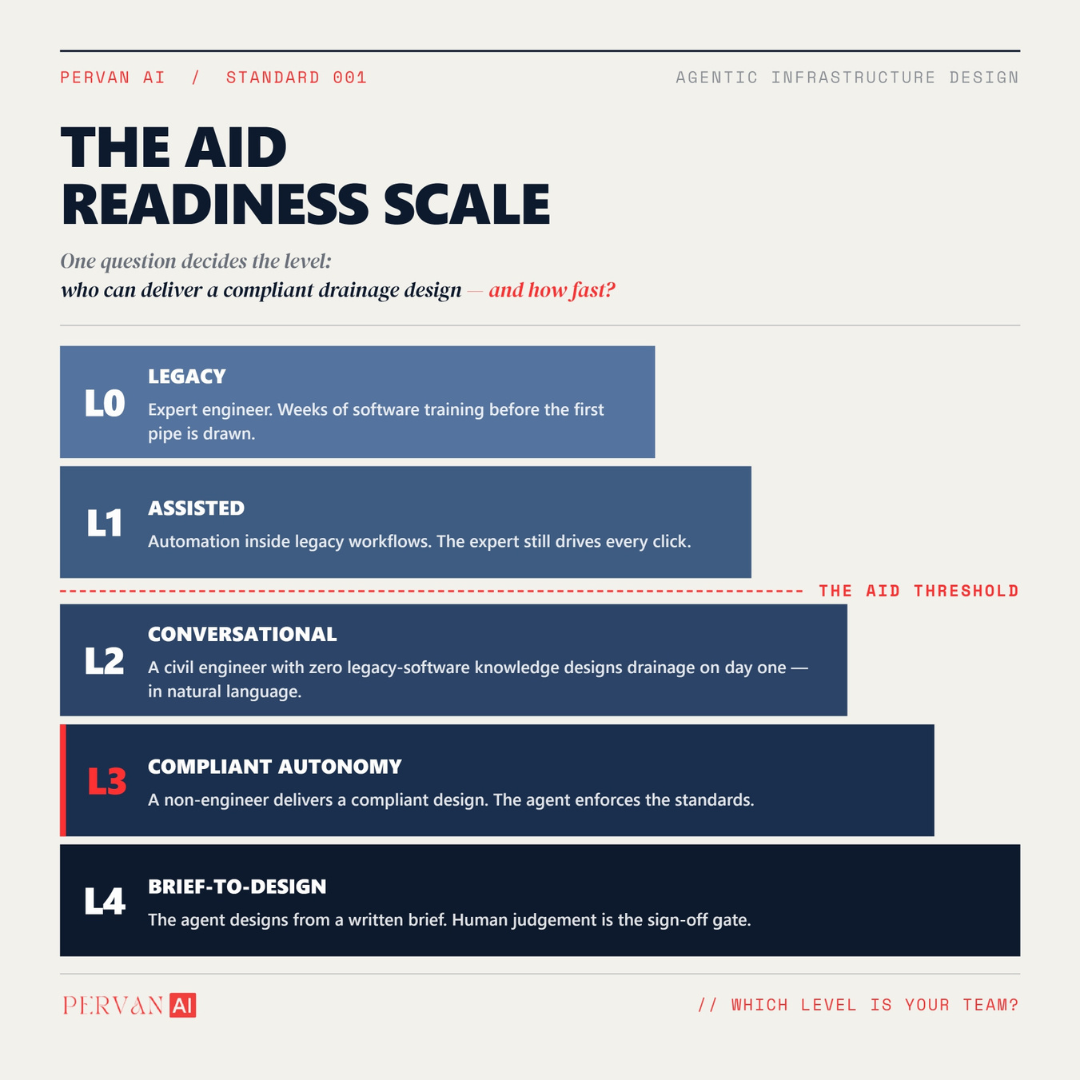
This article gives you the measuring stick: a five-level scale you can hold up against any design software, today, and know exactly where it stands.
I call it the AID Readiness Scale.
One Question Decides the Level
Before I walk you through the levels, understand what the scale actually measures, because this is where most "AI maturity" frameworks go wrong. They measure features. Chat windows. Buttons. Marketing claims.
The AID Readiness Scale measures one thing only:
Who can deliver a compliant drainage design — and how fast?
Not "does it have AI." Not "can it summarise a report." Who can produce a design that meets the standards, and how long does it take them? That is the question your clients care about. That is the question your business depends on. Everything else is noise.
With that question in hand, the levels sort themselves out.
L0 — Legacy
The expert engineer. Weeks and even years of software training before engineers start designing in that software.
This is where the industry has lived for thirty years. Civil 3D. InfoDrainage. MicroDrainage before it. Powerful tools, no question — but tools that demand you become an operator before you can become a designer.
Think about what we actually ask of a graduate engineer at L0. Before they can size a single pipe, they must learn ribbons, menus, styles, layer conventions, and a thousand small workarounds that only exist because the software was architected in a different century. The engineering knowledge they brought from university sits idle whilst they learn to drive the machine.
At L0, the answer to our question is: only a trained expert, and very slowly.
L1 — Assisted
Automation inside legacy workflows. The expert still drives every click.
L1 is where the legacy providers are heading now. Scripts, add-ins, and AI assistants bolted onto the existing software. Autodesk is the obvious example — they have embarked on the L1 path with their AI assistant efforts, and I will give them credit for recognising that the market is moving, but it's a very poor execution.
A chatbot that answers questions about your CAD software is not doing design work. The expert still drives every click. The weeks and years of training in this complex software are still mandatory. The bottleneck — the expert operator — has not moved an inch.
Read that again, because the distinction matters: L1 automates tasks inside the legacy workflow. It does not change who can deliver a design.
At L1, the answer to our question is still: only a trained expert, slightly faster.
And this is why I draw a hard line directly below it.
The AID Threshold
Between L1 and L2 sits the boundary I call the AID Threshold, and it is the most important line on the scale.
Below the threshold, L0 and L1 measure software: how capable the tool is, how much it automates, how polished the assistant feels.
Above the threshold, L2 to L4 measure something entirely different: the accessibility of engineering itself. Who is allowed into the work. How much expertise the tool demands before it gives anything back.
That is not an incremental improvement. It is a change in what the software is. Below the threshold, you operate software. Above it, you direct an agent. No amount of L1 polish gets you across, which is why bolting a chatbot onto a legacy platform — however well-funded the effort — does not produce agentic design software. Real agentic infrastructure design lives at L2 and above.
L2 — Conversational
A civil engineer with zero legacy-software knowledge designs drainage on day one — in natural language.
Here is the first level where our question gets a new answer. At L2, a competent civil engineer who has never opened RUUTE AI in their life sits down and produces a drainage design on day one. No ribbons. No training course. They describe the site, the constraints, the standards — in plain language — and the agent does the modelling.
Notice what changed: the engineering knowledge is still required. The software knowledge is not. Those weeks of training we quietly accepted as the price of entry? Gone. The graduate engineer contributes engineering value in their first week, not 6 months after they are hired.
At L2, the answer is: any civil engineer, on day one.
L3 — Compliant Autonomy
A non-engineer delivers a compliant design. The agent enforces the standards.
L3 is where the scale starts to feel uncomfortable, and I understand why. At L3, the standards knowledge moves into the agent itself. CIRIA C753, local authority discharge requirements, DMRB — encoded, enforced, and checked automatically on every iteration. The agent will not let a non-compliant design through, regardless of who is asking.
Which means a non-engineer — a planner, a technician, a developer's project manager — can request and receive a compliant preliminary drainage design. The agent enforces the standards so the human does not have to hold them all in their head.
Before you object: this does not remove the engineer. It repositions them. Someone still reviews. Someone still stamps. Someone still owns the judgement — and I have argued before that the ability to review and approve, to exercise taste, becomes the greatest engineering skill of the next decade. What L3 removes is the requirement that every single compliant iteration passes through an expert's hands. The expert moves from operator to reviewer. That auditability and accountability structure is not a nice-to-have. It is the whole game.
At L3, the answer is: almost anyone — with the engineer as the quality gate.
L4 — Brief-to-Design
The agent designs from a written brief. Human judgement is the sign-off gate.
L4 is the horizon. You write the brief — the site, the outfall, the constraints, the standards that apply — and the agent takes it from there: sizing, modelling, iterating, checking, documenting. Multiple design iterations whilst you attend to the work that actually requires you. Human judgement does not disappear at L4. It concentrates at the sign-off gate, exactly where it carries the most weight.
Describe it. The agent designs it. You review and approve it.
At L4, the answer is: the brief itself delivers the design. The engineer decides whether it ships.
Where the Industry Actually Sits
So let me place the players honestly on the scale.
The legacy providers — Autodesk chief among them — sit at L0, reaching for L1 with executions that so far do not justify the marketing. I say that without hostility. Retrofitting AI onto a thirty-year-old architecture is almost impossible, and the incentive to protect existing training-and-licence revenue does not help.
The interesting work is happening above the threshold. At RUUTE AI, we sit between L2 and L3 today: natural-language drainage design is real and working, and the standards-enforcement layer that defines L3 — the agent checking every iteration against CIRIA C753 and local authority requirements before a human ever sees it — is making strong progress. I will not pretend we are at L4 atm but we are going there very fast.
This is bigger than any one product, though. The scale is the point. Whoever you evaluate — us included — hold them against it.
What This Means for You
Three things you can do with this scale today.
First, audit your current tools. Ask the one question. If the honest answer is "only our trained experts, slowly," you are running your practice at L0, and you will spend thousands of pounds in hiring skilled legacy design software operators and paying for their expensive software training.
Second, interrogate the AI claims. When a provider company says AI, ask: does this change who can deliver a compliant design, or does it just add a chat window to the same expert-driven workflow? If the expert still drives every click, it is L1 at best.
Third, position yourself above the threshold. The engineers who thrive in the next five years will not be the fastest operators of legacy software. They will be the ones who learned to direct agents, review their output, and apply the high level judgement and engineering taste no agent can supply. The question is not whether the industry crosses the AID Threshold. The question is whether you are positioned on the right side of the transition.
We spent thirty years measuring software. It is time to start measuring the accessibility of engineering itself.
This is why, at PERVAN AI, we are introducing a new discipline: Agentic Infrastructure Design. A different and innovative way of designing infrastructure — one where you describe the outcome, agents do the modelling, and your judgement decides what ships.
The AID Readiness Scale is its first measuring stick. Keep it. Use it on every tool you are shown this year — ours included.